
That nagging feeling of being stuck? It’s often a sign that the life you’re living is out of sync with the person you truly are. It’s that heavy, frustrating sense that you’re spinning your wheels but going nowhere, like running on a treadmill that never moves you forward. This isn’t a sign of failure. It’s a crucial signal that your current path—in your career, relationships, or personal life—has reached its end.
The Overwhelming Feeling of Being Stuck in Life
It can creep up on you. One day you realize you’ve been staring at the same to-do list for weeks. You find yourself replaying the same life choices, wondering where you went wrong. It feels like you’re an extra in your own movie, just watching the scenes play out. This inertia is exhausting, turning even the simplest decisions into massive hurdles. You’re not lazy or uninspired; you’re having a deeply human reaction to a life that just doesn’t fit anymore.

If this sounds familiar, you’re far from alone. Over one billion people across the globe are living with a mental health condition, which translates to roughly 1 in every 7 people. This isn’t just a statistic; it’s a powerful reminder that feeling stuck, overwhelmed, or lost is a shared human experience, not a personal failing. You can dig deeper into these numbers with these global mental health statistics on growtherapy.com.
Key Signs You’re Feeling Stuck
Pinpointing the signs is the first step to figuring out what’s really going on. While everyone’s experience is different, a few common patterns tend to emerge:
- Persistent Lack of Motivation: You just can’t summon the energy for things you used to love. Your goals feel miles away and frankly, not that important anymore.
- Decision Paralysis: Every choice feels impossible, from a major career move to what to eat for dinner. So you end up choosing nothing.
- A Sense of Unreality: You feel detached from your life, like you’re on autopilot. You’re going through the motions, but you’re not really there.
- Repetitive Cycles: You keep having the same arguments, hitting the same professional walls, or falling back into the same bad habits, never breaking free.
Feeling stuck is your inner self sending up a flare. It’s a clear signal that the maps you’ve been following are outdated and no longer lead where you need to go. It’s an invitation to pause and draw a new one.
That’s exactly what this guide is here to help you do. We’ll skip the generic advice and dive into the psychological, situational, and even astrological roots of inertia. Once you understand the why, you can stop blaming yourself and start creating a clear, personalized path forward. This is more than just getting unstuck—it’s about turning this moment of paralysis into your greatest opportunity for real, meaningful change.
The Hidden Reasons You Feel Stuck
That feeling of being stuck rarely comes from a single, obvious problem. It’s more like a tangled knot of threads—some pulling from inside your head, others from your life circumstances. To finally figure out why do I feel stuck in life, we need to gently pull on these threads one by one.
They usually fall into three main areas: your internal psychology, your external situation, and your personal timing.
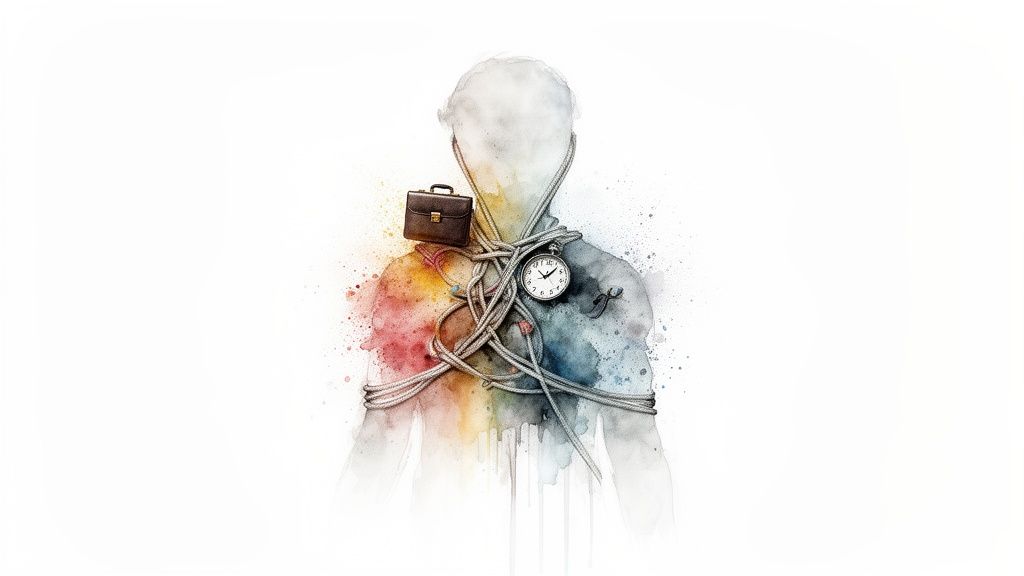
This isn’t about finding someone or something to blame. It’s about switching gears from self-criticism to smart, strategic awareness. Feeling stuck isn’t a life sentence; it’s a solvable equation of mindset, environment, and energy.
Your Internal Psychology: The Mindset Traps
More often than not, the biggest roadblocks are the ones we build in our own minds. These psychological patterns hum along just beneath the surface of our awareness, creating a powerful sense of paralysis without us ever pinpointing the source. Seeing them for what they are is the first real step toward taking them apart.
One of the most common culprits is limiting beliefs. These are the old, often outdated stories we tell ourselves about who we are and what we can do. A belief like, “I’m just not a creative person,” or, “It’s way too late for me to change careers,” can kill your motivation before it even gets a chance to breathe.
Then there’s the crippling fear of making the wrong choice. This is what leads to analysis paralysis, that state where you’re so busy weighing every possible outcome that you never actually make a decision. The fear of regret becomes so intense that staying stuck feels safer than moving forward and potentially messing up. This is especially common for high-achievers who are used to getting things “right.” You can find more practical advice on how to improve self-awareness on our blog.
Your External Situation: The Ruts We Fall Into
While our mindset is a huge piece of the puzzle, our environment plays a massive role, too. Your daily reality can create a powerful inertia, making it feel like you’re fighting a strong current just to keep your head above water, let alone swim to a new shore.
A few common situational ruts include:
- Career Stagnation: You’re in a job that pays the bills, sure, but it offers zero growth or sense of purpose. You stay because it’s safe and familiar, but every day it drains a little more of your spirit, leaving you too exhausted to even think about looking for something else.
- Relationship Ruts: This isn’t just about romantic partners; it can happen in friendships and family dynamics, too. When a relationship stops growing and just settles into repetitive, unfulfilling patterns, it can make your entire life feel stagnant.
- Societal and Family Expectations: The pressure to follow a pre-written life script—get the degree, buy the house, get married, have kids—can be suffocating. When your own authentic desires don’t line up with what you feel you should be doing, you get trapped in a painful limbo.
Feeling stuck is often a sign that the energy you’re putting out doesn’t match the environment you’re in. It’s like trying to grow a plant in the wrong soil; no matter how much you water it, it won’t thrive until its conditions change.
Your Personal Timing: The Art of Sailing
Finally, there’s a factor that most people completely overlook: timing. Think of your life and your energy like you’re sailing a boat. Sometimes, the wind is at your back, and it’s the perfect time to hoist the sails and head for a new destination. Progress feels almost effortless.
At other times, you might find yourself sailing against a brutal headwind or navigating choppy, unpredictable waters. During these phases, trying to push forward with brute force will only leave you exhausted and frustrated. It doesn’t mean you’re a bad sailor; it just means the conditions aren’t right for that specific move. This is a time for patience, minor course corrections, and strategic waiting.
Understanding this concept of personal timing changes everything. It reframes those slow, frustrating periods not as failures, but as necessary pauses. It gives you permission to conserve your energy when the currents are against you, so you can act with power and confidence when the winds finally shift in your favor. This awareness turns “stuckness” from a personal flaw into a strategic challenge of knowing when to push and when to pause.
Are You Stuck or Just Recharging?
Not every pause is a problem. We live in a culture that worships non-stop productivity, so it’s easy to mistake necessary rest for a sign of failure. This leads to a crucial question when you feel adrift: are you truly stuck, or are you just in a vital period of recharging?
Knowing the difference is everything. It’s the first step toward choosing the right action—or embracing intentional inaction.

Think of it like an athlete’s training cycle. Intense workouts are what break down the muscles, but real progress only happens on recovery days. Active rest is intentional and restorative; it’s the quiet, behind-the-scenes work that prepares you for the next big push.
Stagnation, on the other hand, is unintentional and draining. It’s the feeling of being benched indefinitely, watching your strength fade with no game plan in sight.
Figuring out which one you’re in requires some honest self-reflection. Are you consciously stepping back to refuel, or are you passively hiding from the effort it takes to move forward? The answer tells you whether you need to lean into the quiet or find a spark to break the inertia.
Pinpointing the Difference Between Rest and Stagnation
Let’s get clearer on this. The indicators that separate a healthy recharge from a paralyzing rut are subtle but powerful. Your emotional state, what gets you out of bed in the morning, and how you view the future are all major clues.
For example, taking a weekend to do absolutely nothing after a monster project at work is active rest. You made a deliberate choice to recover.
In contrast, avoiding job applications for months because you’re terrified of rejection is passive stagnation. The inaction isn’t a choice; it’s a symptom of being frozen.
The quality of your stillness determines everything. Active rest feels like a deep, satisfying breath that prepares you for what’s next. Stagnation feels like holding your breath, hoping the pressure will just go away.
To help you identify whether you are strategically recharging or caught in a cycle of inertia, the table below breaks down the key differences.
Active Rest vs. Passive Stagnation
| Indicator | Active Rest & Recharge | Passive Stagnation & Paralysis |
|---|---|---|
| Emotional State | You feel a sense of contentment, relief, or even boredom, but it’s generally peaceful. | You feel persistent anxiety, dread, guilt, or numbness about your lack of progress. |
| Daily Motivation | Your actions are intentional. You choose to rest, read, or engage in hobbies to refuel. | You are driven by avoidance. You procrastinate on important tasks out of fear or overwhelm. |
| Energy Levels | Your energy is gradually returning. You may feel tired, but it’s a restorative tiredness. | You feel chronically drained and fatigued, with no sense of replenishment no matter how little you do. |
| Future Outlook | You are hopeful and may be slowly forming plans or ideas for the future. | The future feels foggy, threatening, or completely blank. You avoid thinking about it. |
| Sense of Control | You feel you have agency and have chosen this period of calm for a specific purpose. | You feel powerless, like you are a victim of circumstances with no clear way out. |
Looking at these side-by-side, a pattern usually emerges pretty quickly.
Moving From Diagnosis to Action
After looking over these indicators, your current situation should feel a lot clearer.
If you recognize the signs of active rest, give yourself permission to fully lean into it. This isn’t wasted time; it’s a strategic investment in your long-term success. This quiet phase might be exactly what your mind and body need to process things and gather strength for whatever comes next.
But if the descriptions of passive stagnation hit a little too close to home, that’s your signal that a change is needed. This doesn’t mean you have to make some massive leap overnight. The goal is just to take one small, intentional step to break the inertia.
It could be as simple as updating a single line on your resume, going for a 10-minute walk, or researching one online course.
The key is to shift from passive avoidance to conscious action, no matter how small. Once you correctly identify your state, you can stop judging yourself and start making choices that align with what you truly need—whether that’s the grace of rest or the courage to move.
Personalized Strategies to Find Your Flow Again
Figuring out why you’re stuck is a huge first step. But the real magic happens when you turn that insight into action. The generic advice you see everywhere—”just do it!” or “hustle harder!”—often falls flat because it ignores the most important person in the equation: you. The only strategies that actually work are the ones that resonate with your unique personality, your natural energy patterns, and the specific jam you’re in.
There’s no silver bullet for inertia. What works wonders for one person could be a one-way ticket to burnout for another. The goal isn’t to force yourself into a box that doesn’t fit. It’s to build a personal toolkit that helps you get moving in a way that feels right and, more importantly, lasts.
Play to Your Personality’s Strengths
Your core personality traits are a huge clue, not just to why you feel stuck, but to how you can get unstuck. When you lean into your natural tendencies instead of fighting them, everything gets easier.
Think about it this way: someone who is highly conscientious often gets tangled up in over-planning and perfectionism. They’re so afraid of not doing something perfectly that they end up doing nothing at all. For them, the antidote is imperfect action. The mission is simple: take one small, messy, maybe-not-quite-right step forward. Just one. That’s all it takes to break the spell.
On the other hand, a person who is highly agreeable might feel stuck because they’ve said “yes” to everyone else, leaving no time or energy for themselves. Their path forward isn’t about doing more; it’s about strategically doing less. For them, the game-changer is setting firm, clear boundaries. This could be as simple as saying “no” to one new request or carving out a single hour a week that is unapologetically their own.
Master Your Personal Energy Cycles
Feeling stuck and feeling exhausted usually go hand in hand. Trying to bulldog your way through on sheer willpower is a recipe for disaster. A much smarter approach is energy management—learning to sync your most important tasks with your body’s natural rhythm.
Take a second to think about your typical day. When are you sharp, focused, and ready to go? And when does your brain feel like it’s wading through molasses?
- Energy Peaks: These are your golden hours for “deep work.” This is when you should tackle your most challenging or dreaded tasks—updating your resume, having that tough conversation, or finally starting that new project.
- Energy Troughs: These lulls are perfect for low-effort, administrative stuff. Use this time to clear out easy emails, tidy up your workspace, or handle household chores. Don’t waste your precious energy peaks on these tasks.
By treating your energy like the valuable, finite resource it is, you stop fighting a battle against your own biology. You learn to ride the waves instead of constantly trying to swim against the current.
This simple shift can change everything. Instead of staring at a daunting to-do list at 3 PM and feeling defeated, you’ll have already knocked out your biggest task when you were at your best. That creates a feeling of accomplishment, and that feeling is what builds the momentum you need to keep going.
Use Decision Frameworks to Break the Paralysis
When you’re stuck, every little decision can feel like a monumental, life-altering choice. This is “analysis paralysis,” and it keeps you frozen. To break the cycle, you need a mental tool that lowers the stakes and makes it easier to just pick a path. One of the best is the “two-way door” framework.
This simple mental model, made famous by Jeff Bezos, helps you sort decisions into two buckets:
- One-Way Doors: These are the big ones. They’re hard to reverse and have major consequences, like quitting a stable job with no savings or making a huge, non-refundable investment. These choices deserve slow, careful thought.
- Two-Way Doors: This is almost everything else. These decisions are reversible. If you walk through and don’t like what you see, you can turn around and walk right back out. Trying a new hobby, taking an online class, or going on a single coffee date all fall into this category.
The mistake most of us make when we’re stuck is treating every single choice like a one-way door. We agonize over tiny, low-risk steps, and that’s what keeps us rooted to the spot.
By consciously labeling a decision as a “two-way door,” you give yourself permission to experiment without the fear of permanent failure. This mindset encourages action and learning—the two key ingredients for getting unstuck. For more ideas on breaking out of old patterns, you can explore our other personal growth tips on the blog.
Using Personal Cycles to Find Your Next Step
If you’ve ever wondered, “why do I feel stuck in life?”, you might be overlooking one of the most powerful forces at play: timing. This isn’t about fortune-telling or being locked into some rigid destiny. It’s about a simple, observable truth—your personal energy isn’t a flat line. It moves in cycles, just like the seasons.
Think of it as having your own internal weather forecast. When you know a thunderstorm is coming, you don’t throw your hands up and cancel all your plans for the week. You just grab an umbrella and maybe move that picnic to another day. Working with your internal “weather” is the same. It doesn’t dictate your life, but it gives you the insight to make smarter, more strategic moves.
Some stretches of time feel like a bright, sunny day—everything just clicks. These are the moments when taking a big leap, starting something new, or putting yourself out there feels effortless and exciting. But other times can feel like a heavy downpour, where the smartest thing you can do is stay inside, rest, and plan. Trying to force a major breakthrough during a downpour is just a recipe for getting soaked and feeling defeated.
Identifying Your Energetic Seasons
Just like the world outside has its cycles of growth, harvest, rest, and renewal, you do too. The real breakthrough happens when you stop fighting your natural rhythm and start flowing with it. Pinpointing which “season” you’re in can bring a huge amount of clarity and lift that constant pressure to be “on” all the time.
Here’s a breakdown of what these phases generally feel like and the kinds of actions they support:
- Periods of Expansion (Your Spring/Summer): This is your go-time. You feel optimistic, energized, and ready to connect with the world. It’s the perfect window to launch a new venture, network like a pro, take smart risks, and see how far you can stretch.
- Periods of Contraction (Your Autumn/Winter): This is a quieter, more inward-focused phase. You might feel the pull to withdraw, reflect, and just be still. This isn’t laziness; it’s essential. Use this time for deep thinking, planning your next move, studying, and shedding what’s no longer working.
Feeling stuck is often just a sign of a mismatch between your actions and your energetic season. Pushing yourself to be social and innovative when you’re deep in your “winter” phase will lead straight to burnout. On the flip side, letting a high-energy “summer” phase pass by without taking action can leave you with a sense of regret and missed opportunity.
Aligning your actions with your energy isn’t an excuse to do nothing. It’s about applying the right kind of effort at the right time to get the best results with the least amount of friction.
From Vague Feeling to Concrete Action
So, how do you turn this idea into something you can actually use? It all starts with paying attention. Start noticing your own patterns. Are there certain weeks or months when your creativity is firing on all cylinders? Do you have periods where all you want to do is retreat and organize your life? That’s your data.
Once you get a feel for the cycle you’re in, you can plan with it, not against it.
If you’re in an expansive, high-energy cycle:
- Book that big meeting you’ve been hesitant about.
- Finally hit “publish” on the project you’ve been perfecting.
- Reach out and make some new connections in your field.
If you’re in a contractive, low-energy cycle:
- Dive into research and map out the strategy for your next big goal.
- Tackle that messy desk or organize your digital files—clearing space helps.
- Dedicate time to learning a new skill that will pay off down the road.
- Explore different mindfulness practices to help you reconnect with yourself.
This approach takes timing from a mystical, out-of-your-control idea and turns it into a practical tool. You learn to conserve your energy during the quiet times so you can go all-in with confidence when the moment is right. Instead of fighting the current and feeling stuck, you learn to read the tides. This strategic patience is often the very thing that finally gets you moving again.
Your Roadmap from Stuck to Unstoppable
We’ve explored why we get stuck and how to tell the difference between rest and true stagnation. Now, let’s land on the most important truth of all: feeling stuck is a temporary state, not a life sentence.
That frozen feeling is just a signal. Think of it as an internal alarm telling you that the old maps you’ve been following don’t work anymore. It’s an invitation to pull over, reassess, and chart a new course with better information.
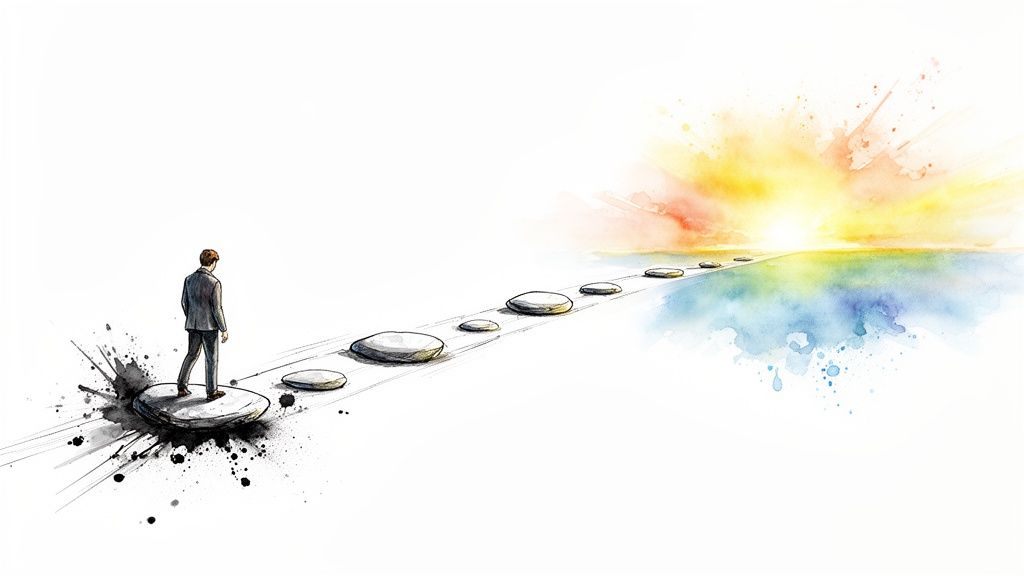
You now have a completely new way to understand why you feel stuck in life. It’s not just one thing—it’s a mix of your inner psychology, your outer circumstances, and your personal timing. This insight alone can shift you from a place of self-blame to one of strategic awareness.
From Powerless to Empowered
The biggest takeaway here is that you have agency. You’re not just a passenger watching your life go by; you’re the one at the helm.
By understanding your own personality and the natural energetic cycles you move through, you can start making choices that actually align with who you are. No more fighting against the current. This is the real difference between just spinning your wheels and finally getting some traction.
The journey out of this rut doesn’t demand some massive, terrifying leap of faith. It starts with a single, informed step, guided by a much deeper understanding of yourself and what this moment is asking of you.
Maybe that step is setting a boundary. Maybe it’s taking messy, imperfect action. Or maybe, it’s consciously choosing to rest. Whatever it is, it’s a deliberate move away from paralysis and toward purpose.
Feeling stuck is the end of one chapter, not the end of your story. It’s the quiet before the breakthrough, the stillness before you consciously choose your next direction and begin to move forward with clarity and confidence.
This guide has given you the tools and perspectives to start building that forward momentum. This isn’t just about getting “unstuck” for a little while. It’s about learning to live a life of conscious, deliberate movement, where you have the insight to navigate whatever comes your way.
Your new path starts now.
Got Questions About Getting Unstuck?
It’s completely normal to have questions when you’re trying to find your way out of a rut. When you feel stuck, everything can feel a bit fuzzy. Let’s clear up a few common uncertainties.
Isn’t This Just “Positive Thinking”?
Not at all. While a positive outlook is a great first step, it often lacks a solid foundation. This approach is much more grounded, combining deep psychological self-awareness with actionable strategies and a real sense of timing.
Think of it this way: positive thinking is like wishing for a sunny day. Our method is like checking the weather forecast, packing the right gear, and knowing the best time to start your hike. You’re not just hoping for the best; you’re creating a concrete plan that actually works with who you are and where you’re at right now.
Can This Help with Real-World Problems, Like My Career?
Absolutely. A stalled career is rarely about a lack of effort; it’s often a problem of mismatched energy and timing. When you learn to read your own personal cycles, you can spot the ideal moments to push for that promotion, start networking for a new role, or simply hunker down and build new skills.
It’s all about making strategic moves at the right time instead of just spinning your wheels and burning out.
“The biggest hurdle to getting unstuck is the feeling of being too overwhelmed to even start. That’s why the focus should always be on the smallest possible action, not on changing your entire life overnight.”
I’m So Overwhelmed, I Don’t Know Where to Start. What Do I Do?
Feeling overwhelmed is the core of being stuck—it’s the paralysis that keeps you in place. The key is to forget about the big picture for a moment and start comically small.
Don’t try to overhaul your life. Just pick one tiny thing from this guide and do it.
- Spend five minutes thinking about just one limiting belief. You don’t have to solve it, just identify it.
- Ask yourself: Am I resting or am I stagnating? Be honest.
- Block out just 15 minutes in your calendar this week to do something purely for fun.
The goal here isn’t a massive transformation. It’s simply to create a tiny spark of momentum. That first small step is always the most powerful.
Ready to stop guessing and start moving with clarity? Cosmic Mind translates your unique personality and real-time astrological data into a practical roadmap. Get your free, personalized reading and discover your next concrete step today at https://cosmicmindmap.com.