If you want to get better at self-awareness, you really only need to do two things: consistently pay attention to what’s happening inside you (your thoughts, feelings, and even physical sensations) and get honest feedback on how you show up to others. It’s that simple—a process of looking in and looking out. This is the bedrock of understanding who you are and how you move through the world.
Why Self-Awareness Is Your Most Important Skill
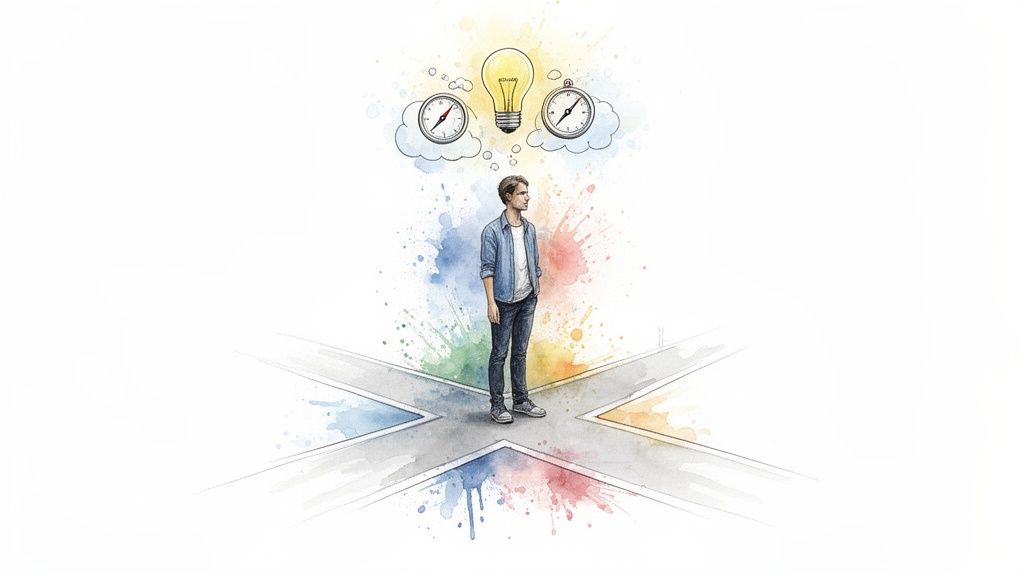
It’s easy to write off self-awareness as a fluffy “soft skill,” but that couldn’t be further from the truth. Think of it as the operating system for your mind. It’s the raw ability to simply notice what you’re thinking and feeling, without immediately judging it or reacting to it. This is what separates being reactive from being intentional, allowing you to shape your life instead of just letting it happen to you.
Without it, you get stuck in loops. Maybe you always leave certain meetings feeling completely drained. Or you constantly overcommit because you’re worried about letting people down. Or you make snap decisions that you end up regretting. Those aren’t just random occurrences; they’re patterns, and they come from your internal wiring.
Self-awareness isn’t a treasure hunt for some hidden, perfect version of yourself. It’s about building an honest, compassionate relationship with the person you are right now. That’s the only real starting point for growth.
This guide isn’t about abstract ideas. It’s a practical, evidence-informed program designed to build this skill with actionable steps that actually stick.
The Growing Demand for Self-Understanding
This hunger for self-knowledge isn’t just a niche interest anymore; it’s a global shift. The self-improvement market is massive, valued between USD 45–48 billion recently, and it’s on track to nearly double by 2034.
Within that boom, the self-awareness segment is predicted to be the fastest-growing niche. This tells us something important. There’s a collective demand for tools that help us make sense of our emotions, our strengths, and our blind spots. You can learn more about these self-improvement industry trends on morningupgrade.com. This isn’t just about money; it’s a reflection of a culture that’s starting to value internal clarity as much as external success.
The Four Pillars of Building Self-Awareness
Building real self-awareness requires a structured approach. You can’t just stumble into it. Think of it like constructing a house—you need a solid foundation and strong, distinct pillars to hold everything up.
This guide is built around four key pillars that work together to give you a complete, 360-degree view of yourself. This framework will keep your efforts focused and effective.
Here’s a quick overview of what we’ll be covering:
| Pillar | Core Activity | Key Outcome |
|---|---|---|
| Reflective Practices | Structured journaling, mindfulness, and energy tracking to map your internal world. | A clear baseline of your thoughts, feelings, and behavioral patterns. |
| External Feedback | Systematically asking for and analyzing input from trusted sources. | Identifying the gap between your self-perception and how others perceive you. |
| Data-Driven Tracking | Using tools to measure progress in energy, mood, and decision-making. | Turning subjective feelings into objective data to spot concrete trends. |
| Actionable Integration | Applying insights to make better daily choices in work and relationships. | Aligning your actions with your values and goals for a more intentional life. |
By working on these four areas, you’ll develop a robust and dynamic understanding of who you are. This isn’t a one-and-done project. It’s a lifelong skill that will help you navigate career changes, manage burnout, and build better relationships with confidence and clarity.
Building Your Foundation with Reflective Practices
You’ve probably heard the advice to “start a journal” a hundred times. But it usually stops right there, leaving you staring at a blank page without a clue what to do next. Let’s be clear: true reflective practice isn’t about aimless scribbling. It’s about becoming a detective of your own mind, systematically gathering clues to understand the hidden patterns driving your daily life.
This isn’t just a nice-to-have skill; it’s becoming a necessity. People are feeling the pressure. Gallup’s recent World Poll found that a staggering 39% of adults worldwide felt worried for a large part of the day, and over a third experienced significant stress. This has driven over 75% of US consumers to actively prioritize their wellness. They’re looking for real tools to get a handle on their internal states. You can get the full picture of the world’s emotional health on gallup.com.
Think of reflective practices as your first line of defense. They provide the raw data you need to start managing these feelings with intention instead of just reacting to them.
Go Deeper Than a Simple Diary
To really move the needle on self-awareness, your journaling has to have a purpose. Instead of just listing what you did, you need to use targeted prompts to dissect why and how you did it. This is how you transform a simple logbook into a powerful analytical tool.
Try starting with these structured prompts to uncover what’s really going on:
- Decision Debrief: At the end of your day, pick one important decision you made. Write down what happened, then ask: “What was the core emotion driving that choice?” Was it excitement? Fear of missing out? A need for comfort? Get specific.
- Reaction Analysis: Think about a moment when you had a strong emotional reaction—good or bad. Don’t judge it; get curious. What was the exact trigger? What did you feel in your body? Maybe a tight chest or a clenched jaw. These physical cues are pure data.
- Peak and Valley Log: Pinpoint one moment where you felt totally in the zone and energized (a peak) and one where you felt drained and foggy (a valley). What was different about the circumstances? Who were you with? What were you doing?
This approach helps you start connecting the dots between your environment, your feelings, and your actions.
Use the Five Whys to Uncover Root Causes
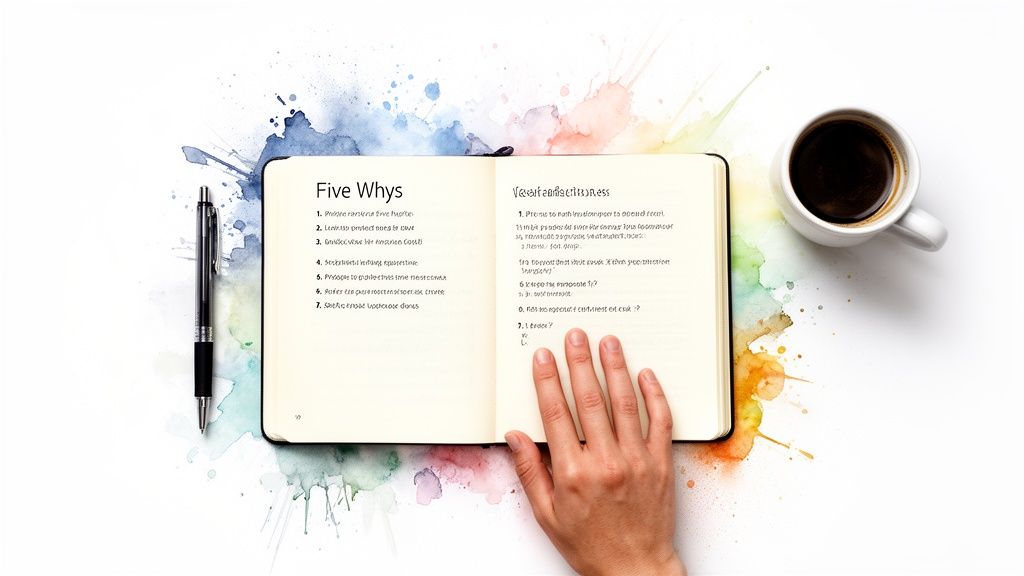
One of the most powerful, yet simple, techniques I’ve used for this is the “Five Whys.” It was originally developed by Toyota for industrial problem-solving, but it works brilliantly for personal introspection. When you notice a recurring behavior or feeling you want to change, this method helps you dig past the surface-level symptoms.
Let’s walk through a common one: procrastination.
- Why did I keep putting off that report? Because I felt totally overwhelmed by it.
- Why did I feel overwhelmed? Because I wasn’t sure where to even start.
- Why wasn’t I sure where to start? Because the brief felt vague, and I was afraid of doing it wrong.
- Why was I afraid of doing it wrong? Because I’m worried my manager will think I’m not up to the job.
- Why do I worry about that? Because I tie so much of my self-worth to my performance at work.
See how that works? We went from a simple act of procrastination all the way down to a core issue of self-worth. That’s the kind of insight that creates a real opportunity for change.
Self-awareness isn’t about finding flaws to fix. It’s about gathering honest information so you can navigate your life with more intention and less friction.
Master Mindfulness in Micro-Doses
Mindfulness doesn’t have to mean an hour on a meditation cushion. You can build profound self-awareness by weaving tiny, focused practices into the moments you already have. The goal is simple: train your brain to notice the present moment without judging it.
Here are a couple of my favorite exercises you can do anywhere, anytime:
- The Coffee Break Body Scan: While you’re waiting for your coffee to brew or your tea to steep, close your eyes for just 30 seconds. Quickly scan your body from your toes to the top of your head. What do you feel? Tension in your shoulders? Your feet on the floor? Just notice it. You don’t have to change a thing.
- Sensation Tracking in a Meeting: Next time you’re in a meeting that’s getting a little tense, secretly shift your focus to a physical sensation for a few seconds. It could be the feeling of your pen against your fingers or the cool air entering your nose as you breathe. This tiny act anchors you in the present and can short-circuit a spiral of anxious thoughts.
These little practices add up. Over time, they sharpen your ability to tune into your internal world in real-time, giving you a rich, continuous dataset of personal insights to build upon.
Uncovering Your Blind Spots with External Feedback

All the self-reflection in the world will only ever give you half the picture. While journaling and mindfulness are fantastic for mapping your inner world, true self-awareness also means understanding how other people experience you.
This is where our biggest blind spots live—in the gap between our intentions and our actual impact. Closing that gap is one of the most powerful things you can do for your personal and professional growth. It takes courage, but without this external perspective, we’re all just operating on an incomplete and often flattering self-portrait.
Research consistently shows a massive gap in how we see ourselves. One eye-opening study found that while 95% of people believe they are self-aware, only a tiny 10-15% of us actually are. That difference isn’t a personal failing; it’s a blind spot created by a lack of honest, external feedback.
It’s a natural human problem. And ironically, the more successful you become, the less likely you are to get the candid feedback you need to keep growing. People become hesitant to challenge you, which can slowly insulate you from reality. The only way to break that cycle is to actively—and skillfully—ask for it.
Asking for Feedback That Actually Helps
Let’s be honest, the biggest mistake we all make is asking a lazy, vague question. “Do you have any feedback for me?” is a classic. It puts the other person on the spot and almost guarantees a generic, polite response like, “You’re doing great!”
If you want real insights, you have to make it easy for people to give you specific, actionable input. This means ditching the broad questions and getting granular. Focus on a specific situation or a recent interaction to give them concrete context to work with.
A simple but incredibly effective framework is the “Start, Stop, Continue” model. It’s direct, easy for anyone to understand, and keeps the focus on behavior, not judgment.
- Start: “What’s one thing I should start doing in our team meetings to be more effective?”
- Stop: “Is there anything I should stop doing that might be holding our project back?”
- Continue: “What’s one thing I’m doing now that you find really valuable and that I should continue?”
This approach feels less like an ambush and more like a coaching conversation, which makes people far more comfortable sharing what they really think.
Specific Scripts for Seeking Input
Having a few go-to phrases ready can take the awkwardness out of asking for feedback. The key is to choose the right person—a trusted colleague, mentor, or manager who you know has your best interests at heart.
Frame your request by explaining your goal is to grow, which shows vulnerability and encourages an honest response.
Let’s look at how to reframe those ineffective questions into something that will get you real answers.
Effective vs. Ineffective Feedback Requests
Asking the right question is everything. A vague query gets you a vague answer, but a specific, behavior-focused question gets you pure gold.
| Ineffective Question (Vague) | Effective Question (Specific & Actionable) |
|---|---|
| “Got any feedback for me?” | “I’m working on my presentation skills. In that client call yesterday, was there a moment where my explanation was unclear or a point where I could have been more persuasive?” |
| “How am I doing?” | “I’m trying to improve how I handle disagreements. When we were debating the project timeline last week, how did my communication style come across to you?” |
| “What can I do better?” | “Thinking about the last project we completed together, what is one thing you observed that you think I might not be aware of?” |
See the difference? The effective questions are tied to a specific event and focus on observable behavior. This gives the other person a safe, narrow lane to give feedback in and provides you with concrete data you can actually use.
Processing Feedback Without Getting Defensive
Receiving feedback well is a skill in and of itself. Our gut reaction is often to defend ourselves, but that shuts down the entire learning opportunity. When you’re on the receiving end, your only job is to listen and understand.
Keep these three things in mind:
- Listen to Understand, Not to Reply. Resist the urge to interrupt, explain, or justify your actions. Your goal is simply to absorb what they’re saying.
- Ask Clarifying Questions. Use phrases that encourage more detail, like, “Can you give me a specific example of when you saw that?” or “Tell me more about what that looked like from your perspective.”
- Show Gratitude. Always thank the person for their courage and honesty. A simple, “Thank you, this is really helpful to hear,” makes them feel valued and much more likely to share insights with you again.
Once you have this external data, bring it back to your own reflections and journals. Where does their story align with yours? Where does it diverge? Those gaps between your intent and your impact are your single greatest opportunities for growth. Triangulating your internal view with an external one is how you build a truly accurate and powerful sense of self.
Tracking Your Progress with Data-Driven Tools
All the reflection and feedback in the world gives you a great starting point, but if you really want to accelerate your growth, you need to get objective. You need data.
Thinking like a data analyst about your own life isn’t about being cold or robotic. It’s about spotting the real-world patterns your own mind is brilliant at overlooking. It’s the difference between a vague feeling like, “I’m always tired,” and a concrete insight like, “My energy consistently tanks by 40% after any meeting that runs over an hour.”
That shift—from guessing to knowing—is where the magic happens. You stop treating the symptoms and start fixing the actual problems.
Creating Your Personal Energy Dashboard
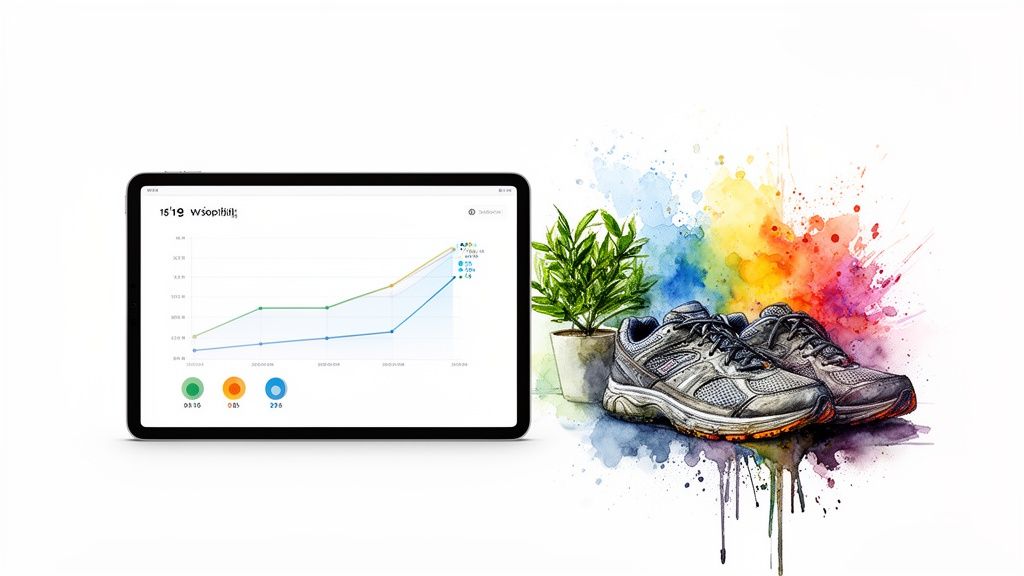
The easiest way to get started is with a simple spreadsheet. Think of it as your personal “Energy Dashboard.” The goal isn’t to create something complex; the real power comes from logging a few key metrics consistently.
At the end of each day, take just a couple of minutes to track the inputs (what you did) and the outputs (how you felt).
Here are a few columns you can start with:
- Date: The day you’re logging.
- Sleep Quality (1-10): How rested did you actually feel when you woke up?
- Focus Level (1-10): How easy was it to concentrate on your most important work?
- Mood (1-10): A quick gut-check on your overall emotional state.
- Key Activity: The one thing that defined the day (e.g., “Client presentation,” “Deep work on project,” “Difficult conversation”).
- Nutrition Note: A quick note on food (e.g., “Ate clean,” “Too much sugar,” “Skipped lunch”).
After just two weeks, you’ll have enough data to see real trends. Chart your focus level against your sleep quality. Does your mood improve on days you get outside? The patterns will jump right out at you.
Uncovering Hidden Patterns in Your Data
Once you have this raw data, you can start asking much smarter questions. You’re not just looking for the obvious stuff; you’re hunting for the subtle dynamics that secretly shape your performance and well-being.
The point of tracking isn’t to judge yourself for “bad” days. It’s to figure out the exact conditions that create your best days, so you can replicate them on purpose.
For instance, you might notice your focus doesn’t just dip randomly on Tuesday afternoons. Looking at your dashboard, you realize it happens right after that weekly team sync you secretly dread. Now you have something actionable. You could schedule a 15-minute walk right after the meeting to reset, or maybe it’s time to talk with the team about the meeting’s structure.
This data-driven approach takes the emotional guesswork out of self-assessment and replaces it with objective curiosity.
The Next Frontier: AI-Powered Self-Insight
Spreadsheets are a fantastic start, but modern tools are taking this to a whole new level. They combine psychological frameworks with intelligent software to create a deeply personalized feedback loop.
Platforms like Cosmic Mind go beyond manual tracking by connecting multiple data points—your unique psychological profile, real-time inputs, and a strategic AI—to give you insights that adapt as you change.
This is a huge leap forward for self-awareness. By 2034, the market for AI-enabled self-improvement is expected to hit nearly USD 90 billion, showing just how much we’re moving beyond simple journaling. You can read more about the growth of the self-improvement market on custommarketinsights.com.
Instead of you having to connect the dots, these systems can spot correlations you’d never see on your own. It might notice that you make your best creative breakthroughs during specific astrological transits that align with your personality, or that your decision-making is sharpest at a certain time of day. This is the future of introspection: a partnership between your own reflection and machine intelligence, built to help you understand yourself with a clarity that was never before possible.
Putting Your Self-Awareness into Action
All that data you’ve gathered—the journaling, the feedback, the assessments—is fascinating stuff. But right now, it’s just a collection of interesting facts about yourself. The real magic happens when you start using those insights to make better choices, day in and day out. This is where self-awareness stops being a concept and starts becoming a practical tool.
Think of it this way: you’re not trying to become a totally different person. You’re simply learning how to operate the unique, complex system that is you with more skill and precision. The goal is to align what you do with who you are, which creates a whole lot less internal friction and a whole lot more momentum.
From Insight to Daily Strategy
So, how does this actually look in the real world? Self-awareness isn’t just for navel-gazing; it’s a blueprint for designing a life that actually fits you, instead of one you’re constantly fighting against.
Let’s say you’ve figured out you’re a classic introvert. It’s not that you dislike people, but you know that a day packed with back-to-back social interactions leaves your battery on empty.
Armed with this knowledge, you can stop just white-knuckling it through the week.
- Before: You’d accept every meeting invitation as it came, ending most days feeling completely drained and irritable, without really understanding why.
- After: Now, you proactively block out a 90-minute “deep work” session on your calendar every morning. You might try to cluster your meetings in the afternoon and schedule a 30-minute buffer afterward for quiet admin tasks, giving yourself a chance to recharge.
See the difference? It’s not about avoiding people. It’s about managing your energy so you can be fully present and effective when you are with them.
Here’s another scenario. Maybe a personality assessment like the Big Five revealed you score high on neuroticism. This simply means you’re wired to feel emotions like anxiety and stress more intensely than others. Instead of seeing this as some kind of character flaw, you can treat it as a crucial piece of operational data about your own system.
You know a huge project deadline is coming up. The old you might have just tried to power through, getting more stressed and snippy with each passing day. The self-aware you, however, can see this coming. You can build a support system ahead of time—maybe by scheduling shorter work blocks, making sure you get a walk in at lunch, or letting your team know you need to minimize distractions to stay focused.
Self-awareness transforms your personal traits from things that just happen to you into information you can actively use. You stop being a victim of your own wiring and start becoming its architect.
A Simple Framework for Intentional Decisions
When you’re in a high-stakes moment or find yourself emotionally triggered, it’s all too easy for your hard-won self-knowledge to fly right out the window. To prevent that, you need a simple, repeatable framework to bridge the gap between knowing and doing.
One of the most powerful tools I’ve come across is the ‘Pause, Analyze, Choose’ framework. Its entire purpose is to create that tiny, crucial space between a stimulus and your response, giving you just enough time to act consciously instead of reactively.
Here’s how to put it into practice.
1. Pause
This is the most important step, and honestly, it’s often the hardest. The second you feel that strong emotional pull—anger, anxiety, even overwhelming excitement—your only job is to stop. It doesn’t have to be a long, meditative break. A single, deep breath is usually enough to interrupt the knee-jerk impulse. That one breath creates the mental space you need for what comes next.
2. Analyze
In that brief moment of stillness, you do a quick scan, like a pilot checking their instruments before making a maneuver. You’re gathering data from three key sources:
- Emotional Data: What am I feeling right now? Put a name on it. Is it frustration? Fear? Defensiveness? Don’t judge the feeling, just identify it.
- Rational Data: What are the cold, hard facts of this situation? What is my ultimate goal here? What would a purely logical response look like?
- Situational Data: What’s the context? Who else is involved? What are the likely consequences of my different options?
3. Choose
With that quick, 360-degree view, you can now make a choice that is both aligned with your goals and intentional. Your action is no longer just a raw emotional reaction or a cold, calculated move. It’s an integrated decision that takes your feelings, your goals, and your environment into account.
Let’s walk through an example. Imagine a colleague gives you some unexpectedly harsh feedback in a team meeting.
- Pause: You feel a hot flash of anger and embarrassment. Before you say a word, you take one slow, deep breath.
- Analyze: You identify the emotion as defensiveness. Your rational brain reminds you that your goal is to maintain a good working relationship and actually learn from the feedback, if possible. The situation is public, so a heated argument would be a bad look for everyone.
- Choose: Instead of lashing out, you say, “Thanks for the feedback. I want to make sure I understand it correctly. Can we grab 15 minutes after this meeting to go over it in more detail?”
That right there is self-awareness in action. You took a moment that could have easily spiraled into conflict and turned it into a productive opportunity—all by applying a simple framework. Mastering this is how you start to consistently align your actions with your bigger goals, building a life that feels authentic and works for you.
Answering Your Questions About Self-Awareness
As you start putting these ideas into practice, you’re bound to have some questions. This isn’t a simple, straight-line journey, and knowing how to handle the common bumps in the road can make a huge difference. Here are some of the most common things people ask when they get serious about building self-awareness.
How Long Does It Take to Actually See Results?
This is usually the first question on everyone’s mind, and the only honest answer is: it depends. You can absolutely feel small, immediate shifts the very first day you try something like energy tracking. That single “aha!” moment when you realize why a certain meeting always leaves you drained? That’s a real, tangible result.
But let’s be realistic—rewiring your deep-seated patterns and default reactions is a longer game.
- In the first month (Weeks 1-4): You’re in the pattern-spotting phase. This is all about collecting the raw data and starting to connect the dots between your moods, energy levels, and the choices you make.
- A few months in (Months 1-3): You’ll start to get ahead of your reactions. You’ll see a stressful situation on the horizon and have the presence of mind to actually use a strategy, like the ‘Pause, Analyze, Choose’ method we talked about earlier.
- Beyond three months (Months 3-6+): This is where the magic happens. Those intentional, conscious responses start becoming second nature. The new, more aware neural pathways get stronger, and you find yourself navigating challenges with more grace and less brute force.
Remember, consistency beats intensity every time. A five-minute daily check-in will do more for you than a two-hour journaling marathon once a month.
Is It Possible to Be Too Self-Aware?
A brilliant question, because it gets at a critical distinction: the line between self-awareness and rumination. True self-awareness is about objective observation—it’s noticing your thoughts and feelings without judging them. Rumination is when you get stuck on a negative feedback loop, endlessly replaying mistakes or chewing on anxieties.
Self-awareness is curiosity in action; it asks, “What can I learn from this?” Rumination is self-criticism on a loop; it asks, “Why am I like this?”
If you find yourself over-analyzing every tiny detail to the point of paralysis, you’ve probably slipped into rumination. The best antidote is to shift from internal analysis to external action. Go for a walk. Call a friend. Focus on a simple, tangible task. Awareness should be a tool that empowers you, not a cage that traps you in your own head.
What’s the Difference Between Self-Awareness and Self-Consciousness?
They feel related, but they’re worlds apart in practice.
Self-consciousness is an outward-facing anxiety about how you think others see you. It’s rooted in a fear of judgment and is the source of that awkward, anxious feeling you get when you walk into a room and worry everyone is staring at you.
Self-awareness, on the other hand, is an inward-facing skill. It’s about deeply understanding your own internal landscape—your values, emotions, triggers, and patterns—completely separate from anyone else’s opinion. It’s about having your own internal anchor. A self-aware person can walk into that same room, notice a jolt of anxiety, and simply think, “Ah, I’m feeling a bit anxious because this is a new environment,” without getting completely derailed by the feeling.
How Can I Practice This If I Have No Free Time?
I get it. Life is busy. You don’t need to carve out an hour a day for silent meditation to build this muscle. The key is to integrate tiny “micro-habits” into the day you’re already living.
- The Two-Minute Transition: In the space between finishing one task and starting the next, just pause. Close your eyes for two minutes and ask, “What’s my energy level? What’s the primary emotion I’m feeling right now?”
- The Red Light Check-In: Use everyday triggers as your cue. Every time you stop at a red light, use it as a reminder to take one deep breath and notice where you’re holding tension in your body. Let your shoulders drop.
- The “Why” Before You Reply: Before hitting ‘send’ on an important email or text, take a five-second pause. Ask yourself, “What’s my real intention with this message?” Is it to help, to prove a point, to defend yourself?
These tiny, consistent acts weave awareness into the fabric of your day. It proves you don’t need more time—you just need more intention with the time you have.
Ready to move from manual tracking to a more dynamic system? Cosmic Mind triangulates your psychological profile with real-time data to deliver personalized, adaptive insights. It turns your introspection into a powerful feedback loop for accelerated growth. Start your journey for free at https://cosmicmindmap.com.