We've all looked for a map to help us navigate our lives. For thousands of years, astrology has offered one. This guide gets right to the heart of the matter: just how accurate is this map? We’re going to look past the daily sun-sign horoscopes to explore what science, psychology, and modern data can tell us about astrology’s real power.
Your Search for Cosmic Clarity
Think of this as a journey of discovery, not dismissal. Our goal is to honor your curiosity while grounding it in real evidence. To start, let's see how the traditional approach stacks up against a modern, data-driven one. It’s not just about whether astrology works, but how it could work better for you.
Many of us feel that pull—that intuitive sense that bigger cosmic cycles might connect to our personal energy, moods, and choices. That feeling is completely valid. It speaks to a deep human desire for meaning. Maybe you've read a horoscope that felt spot-on, or you’ve noticed life patterns that seem to sync up with the stars.
This is exactly where the conversation about accuracy gets interesting. The idea isn’t to dismiss your experience, but to give you a clearer lens to see it through.
The real search is not for a system that gives you all the answers, but for one that asks the right questions about who you are and what you're capable of.
True guidance helps you make better choices; it doesn’t just hand you predictions. A modern approach respects this by moving away from vague prophecies and toward strategies you can actually use. It’s about turning a mystical art into a practical tool.
Two Paths to Understanding
When we talk about astrological accuracy, we’re really talking about two completely different ways of seeking insight. Each has its own purpose and delivers a different kind of value.
- Traditional Astrology: This path is built on ancient archetypes and symbolic meanings passed down for centuries. Its accuracy often feels personal and subjective, relying on generalized traits tied to the 12 zodiac signs.
- Data-Driven Astrology: This modern path combines real-time astronomical data with your validated psychological profile. It swaps generic predictions for personalized strategies based on how cosmic energies might specifically interact with your unique personality.
This distinction changes everything. One offers broad, universal themes, while the other gives you a precise, personalized roadmap. Exploring topics in personal development can show just how much more powerful customized insights are for genuine growth.
Let's break down how these two approaches compare when it comes to delivering clarity you can actually act on.
Traditional Astrology vs Data-Driven Insights at a Glance
This table lays out the core differences between the generic horoscopes many of us are familiar with and a modern, personalized system. The contrast in methodology and verifiable accuracy is striking.
| Aspect | Traditional Astrology | Data-Driven Astrology |
|---|---|---|
| Foundation | Ancient symbolic archetypes and generalized traits for 12 sun signs. | Your unique, validated psychological profile (e.g., Big Five). |
| Data Source | General planetary positions interpreted through a historical lens. | Real-time NASA astronomical data, triangulated with your personality. |
| Output | Vague, predictive horoscopes that apply to millions of people. | Actionable, personalized strategies for energy and decision-making. |
| Verification | Subjective; accuracy is based on personal feeling and interpretation. | Objective; insights are calibrated to your known psychological traits. |
Ultimately, the goal is to find a system that resonates with you and provides tangible value. Seeing the two side-by-side helps clarify what you're really getting from each approach.
Putting the Stars to the Scientific Test
When we wonder about astrology's accuracy, what we’re really asking is simple: can we measure it? Can its claims be tested in a way that’s reliable and repeatable? Science gives us a framework for exploring this, helping us move past personal feelings and stories to find clear, objective evidence. The goal isn't to strip away the magic, but to see if there's a real, measurable phenomenon humming beneath the surface.
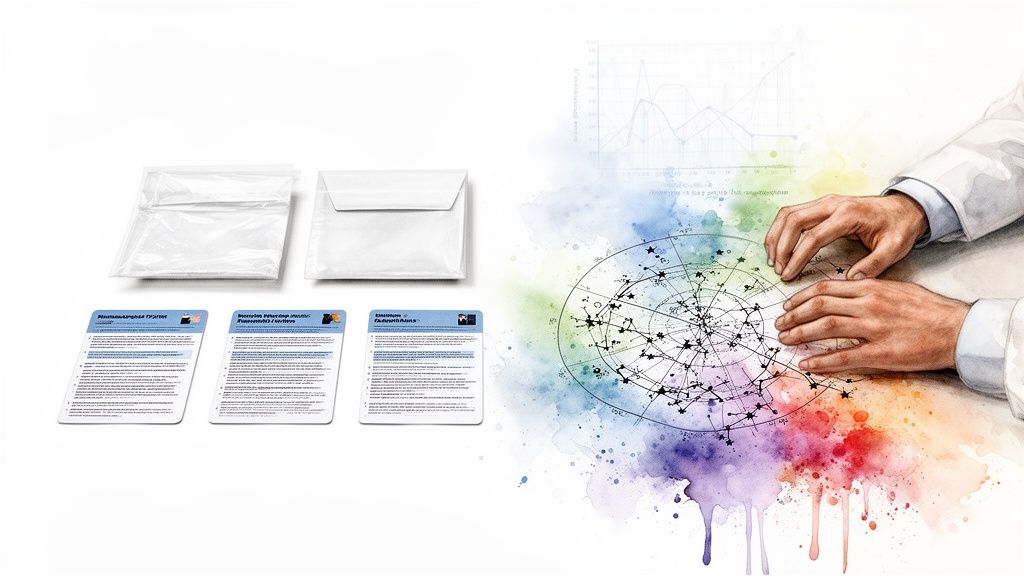
Think of it like a taste test. A soda connoisseur claims they can pick out a specific brand every time. To see if they’re right, you'd have to pour the sodas into identical cups, hiding the labels so they can't be influenced. That’s the core idea of a double-blind study—the gold standard for testing claims in countless fields, and a perfect tool for astrology.
In a setup like this, neither the astrologer nor the person running the test knows which chart belongs to which person. It’s a beautifully simple way to remove all the subtle clues, unconscious biases, and lucky guesses that could skew the results. It creates a truly level playing field, where a genuine skill has every chance to shine.
The Gold Standard Experiment
This brings us to one of the most famous and carefully designed attempts to see if astrology works as advertised. Back in 1985, a physicist named Shawn Carlson conducted a rigorous double-blind test to find out if professional astrologers could actually outperform random chance. The experiment was elegant in its fairness.
He gathered 30 experienced astrologers and gave them a set of birth charts. For each chart, they were also given three anonymous personality profiles. One of these profiles was the correct match for the chart, while the other two were decoys. The theory was straightforward: if a natal chart accurately maps a personality, the astrologers should be able to pick the right profile with significant success.
The results spoke volumes. With three possible answers, pure random guessing would get you the right one about 33% of the time. So, how did the professional astrologers do? They correctly matched the personality profile to the birth chart… 33% of the time. Exactly what you’d expect from sheer chance. If you’re curious, you can dig into the details and what it all means for astrology's testable accuracy.
This doesn't mean the personal meaning people find in astrology is invalid. What it does show is that when we isolate specific, testable claims and put them under the microscope, their predictive power seems to disappear.
What This Means for Your Journey
This kind of scientific scrutiny isn't about proving astrology "wrong." It’s about adding a crucial piece to the puzzle. It tells us that broad, generalized predictions based on a birth chart alone don't seem to hold up in a controlled environment. But this finding isn't a dead end—it's a signpost, pointing us toward a more sophisticated and powerful path.
It invites us to ask better questions:
- If birth charts alone aren't reliable personality predictors, what elements are we missing?
- How can we respect the intuitive wisdom of cosmic cycles while also grounding our insights in something we can actually verify?
The answer is a fundamental shift in perspective. Instead of asking the stars to define us with ancient archetypes, what if we started with ourselves? By using our own verified psychological data as the anchor, we can put our unique identity at the center of the story. Then, astronomical data becomes a lens to look through, not a label to live under.
It’s about moving from prediction to personal strategy.
Why Horoscopes Feel So Personally True
If the hard data often shows astrology's predictions don't quite hold up, why does your daily horoscope sometimes feel like it was written just for you? That uncanny feeling of connection is very real, and it points to something incredible about the way our minds work. It has nothing to do with being naive; it’s about our brain’s profound gift for finding meaning and weaving a coherent story out of the world around us.
This phenomenon has a name: the Barnum Effect. It’s a well-known psychological principle where people rate personality descriptions as highly accurate, believing they are tailored specifically for them, when in fact, the statements are vague enough to apply to almost anyone. It’s a beautiful testament to our innate drive to see ourselves and be understood.
Think about a line like, “You have a great need for other people to like and admire you, yet you tend to be critical of yourself.” Honestly, who can't relate to that? Our minds instinctively grab onto these universal truths, filter them through our own personal history, and instantly validate them.
The Power of a Positive Mindset
There's another powerful force at play here: our natural lean towards confirmation bias. This is simply our brain’s habit of cherry-picking the evidence that confirms what we already believe and conveniently overlooking anything that doesn't fit.
When your horoscope mentions a “financial opportunity,” you’ll remember that twenty-dollar bill you found on the sidewalk with crystal clarity. But you'll likely forget it also predicted a dramatic turn in your love life that never happened. We're wired to remember the hits and forget the misses.
This isn’t a flaw in our wiring; it’s a feature. It’s how we build the empowering narratives that give our lives meaning and help us make sense of the journey.
The human mind is not a passive receiver of information but an active creator of meaning. It takes the raw material of a generic statement and transforms it into a personal, motivating truth.
This psychological dance doesn't make your experience any less valid. In fact, it celebrates the mind's amazing ability to set expectations and create self-fulfilling prophecies. Believing you are destined to be more confident or courageous this week can actually be the spark that makes it happen. The horoscope becomes a permission slip to step into the qualities you already wish to embody.
When we feel stuck, it's natural to look for external signs to point the way forward. You can start to break these cycles by exploring the deeper reasons for why you feel stuck in life and using that self-awareness to chart a new course. The goal isn’t to stop seeking guidance, but to find a source that begins with your unique, individual truth instead of a generic one.
The Unresolved Problem of Time Twins
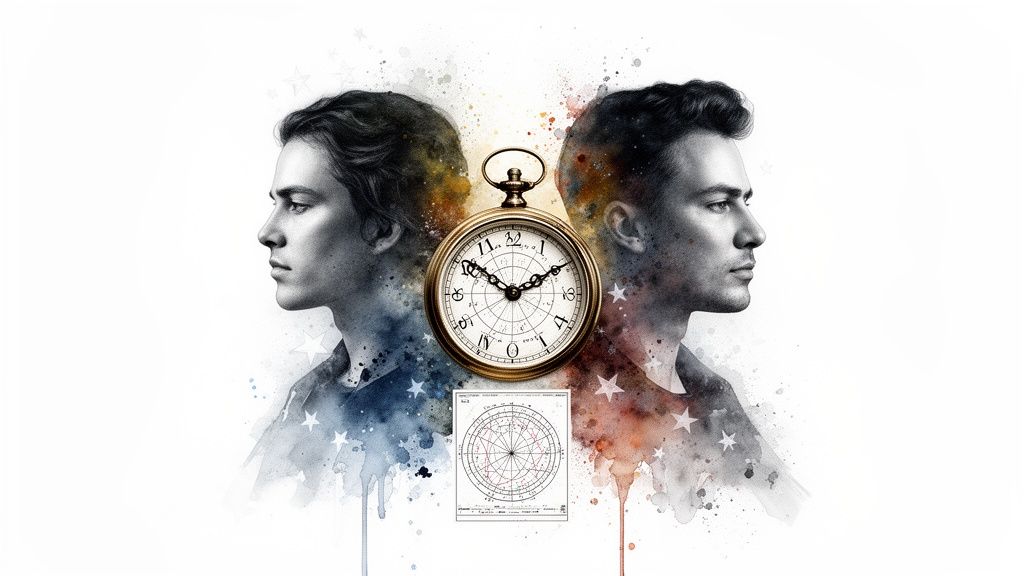
Let's dive into one of astrology's biggest claims with a simple but profound thought experiment. Picture two people born just minutes apart in the same hospital. Natal astrology would give them nearly identical birth charts, essentially a shared cosmic blueprint for their personalities, life paths, and destinies.
These individuals are known as “time twins.” If the planets at the moment of our birth really do shape who we are, then these two people should live remarkably similar lives. They ought to share personality traits, walk down similar career paths, and hit major life milestones in tandem. It’s a beautifully clear test of astrology at its most fundamental level.
So, when we go looking for these mirrored lives, what does the evidence actually show?
A Cosmic Knockout Punch
This isn't just a hypothetical scenario; it’s been studied on a massive scale. Researchers have followed the lives of thousands of time twins, searching for any statistical patterns that could point back to their shared birth chart. The results, frankly, deliver a powerful blow to the idea that our birth moment locks in our destiny.
One huge analysis looked at 2,101 pairs of people born within minutes of each other. If the stars truly imprinted their mark, these cosmic twins should have shown similarities in everything from IQ and temperament to their relationships and careers. And yet, the study found no discernible effects whatsoever. You can dig into the specifics of these astrological studies and their findings for yourself.
This is one of the most compelling pieces of evidence we have. It strongly suggests that while the stars might inspire us, they don't seem to bind us to a predetermined path.
The time-twin problem highlights a core challenge for astrology: its claims are often so flexible that they become impossible to prove or disprove. This is a concept known as falsifiability.
The Challenge of Falsifiability
For a claim to be scientifically useful, you have to be able to test it and, importantly, prove it wrong. For example, if I claim “all swans are white,” you just need to find one black swan to falsify my statement. Astrology, however, works with interpretations that are often symbolic and open-ended.
If a time twin doesn't match their chart’s profile, an astrologer might point to other subtle planetary influences or suggest the chart was misinterpreted. This creates a system where evidence against a claim can always be explained away, making it incredibly difficult to pin down and verify.
This adaptability is exactly what makes astrology feel so personal and resonant, but it’s also what keeps it from being a reliable, predictive system.
This isn’t about taking away from the personal meaning people find in the stars. Instead, it invites a more powerful question: if our birth moment isn’t the definitive map, what is? Perhaps the answer lies not in starting with a universal chart, but with our own unique, measurable psychology.
What Big Data Reveals About Zodiac Signs
We've all heard the classic descriptions: Leos are natural-born leaders, Virgos are perfectionists down to the last detail. These archetypes are part of our cultural fabric, a quick and easy way to categorize people. But what happens when we test these age-old beliefs against the power of modern data? The answer is surprisingly freeing.
Thanks to our ability to analyze personality traits across millions of people, researchers can now hunt for real, statistical links between birth dates and character. It’s here that the story gets really interesting.
Time after time, these massive studies come up empty. The data shows that a fiery Aries is no more assertive than a gentle Pisces. A balanced Libra isn't statistically more fair-minded than a determined Scorpio. When you put them under the microscope of rigorous analysis, the familiar stereotypes just don't hold up.
Breaking Free From Cosmic Boxes
This isn't bad news—far from it. Think of it as a powerful invitation to see yourself with fresh eyes. This data doesn't erase your identity; it celebrates your complexity. You are far too unique, too multifaceted, to be neatly tucked into one of twelve predetermined boxes.
Your personality is a living, breathing story that you write every day. It is not a fixed script written in the stars at the moment of your birth.
This shifts the entire journey of self-discovery onto more authentic ground. Instead of trying to force yourself into a cosmic mold, you can begin with the truth of who you are, right here and now. The data points to a reality where our character is a beautiful, messy mix of genetics, life experience, and the choices we make for ourselves.
One major analysis even called zodiac stereotypes "outmoded mythology" after finding zero personality patterns linked to birth dates across its huge dataset. The evidence leads us to a more empowering conclusion: you are the author of your own story. You can dig deeper into the findings from these zodiac personality studies to see for yourself.
This frees you from the limitations of a single sign and opens up a much more dynamic way of understanding your own potential. When you let go of the labels, you finally make room for your true self to shine through.
Evolving from Vague Predictions to Actionable Insights
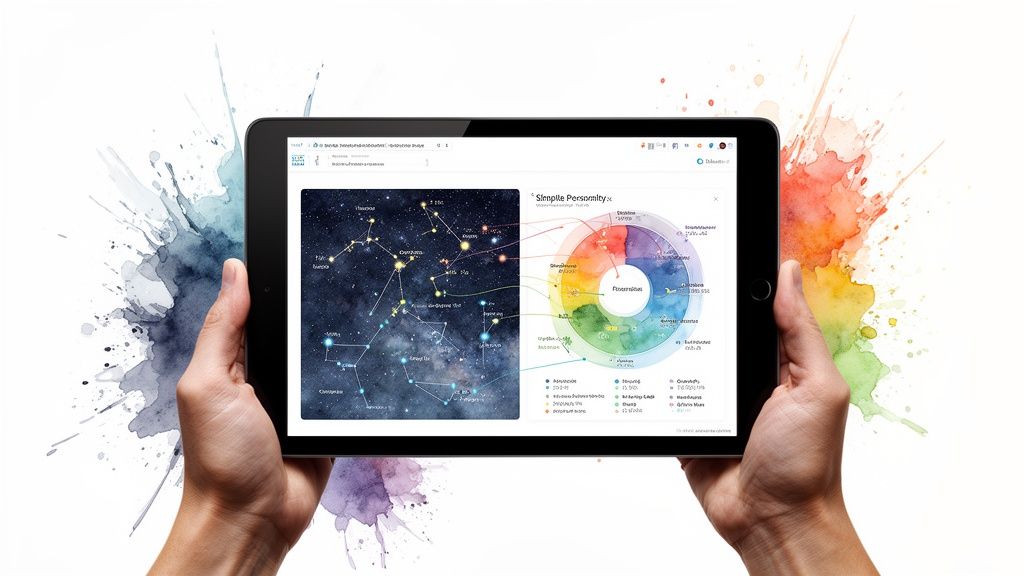
It’s a powerful and timeless instinct to look up at the stars and feel a connection. We sense that the vast patterns of the cosmos might somehow mirror our own inner worlds. What if we could honor that deep human impulse with a system built for today—one that replaces vague predictions with genuine, personal clarity?
This is where the next evolution in self-discovery begins. We start by shifting the fundamental question from "What will happen to me?" to "Who am I, and how can I best navigate my life right now?" Instead of trying to fit ourselves into ancient archetypes that apply to millions, this modern approach puts your unique, validated psychological profile right at the center of your story.
It’s a fundamental upgrade to the entire process.
From Cosmic Weather to Personal Strategy
Think of traditional astrology like a national weather forecast. It might predict "sunshine with scattered showers," which is so broad it's not very helpful for planning your day in a specific town. A data-driven approach, on the other hand, is like getting a hyper-local forecast for your exact neighborhood, telling you precisely how that weather will impact you.
This level of precision comes from combining two powerful streams of information:
- Real-time astronomical data: This is the "weather"—the objective, measurable positions of the planets, sourced directly from NASA.
- Your psychological profile: This is your personal "filter"—your verified personality traits, like your levels of Extraversion, Conscientiousness, and Openness.
By weaving these two inputs together, the system can generate insights that are truly personal. It can explain why an intense Mars transit might feel energizing and motivating for one person but agitating and stressful for another, all based on their unique psychological wiring.
The goal is no longer to guess the future. It's to give you a personalized user manual for your own mind, helping you manage your energy, make smarter decisions, and understand your reactions with much greater clarity.
This changes everything. Vague prophecies become actionable strategies grounded in who you really are. It's about building a deeper connection with your inner workings, a process that gets stronger as you learn how to improve self-awareness in all parts of your life.
This method transforms astrology from a passive system of belief into an active tool for personal growth. It gives you a reliable framework for understanding why you feel the way you do and offers concrete guidance for moving forward with confidence and intention. The focus shifts from untestable predictions to empowering you with knowledge about yourself.
Answering Your Biggest Questions About Astrology's Accuracy
Let's tackle some of the most common questions that come up when we talk about how accurate astrology really is. Think of this as a quick-and-easy guide to connect the dots and see the bigger picture.
If Studies Show Astrology Is Inaccurate, Why Does My Horoscope Feel So Right?
That "aha!" moment when you read your horoscope is a powerful, genuine feeling. It's also a perfect example of a psychological principle known as the Barnum Effect. Our minds are wired to find personal relevance in vague statements that could easily apply to just about anyone.
So, while that feeling of being seen is completely real, it often tells us more about the incredible way our brains work than about the stars. A data-driven approach respects that search for meaning but grounds it in your actual personality, creating insights that are truly, uniquely yours.
Are All Forms of Astrology Inaccurate?
Most scientific studies have to focus on testable, black-and-white claims—like asking an astrologer to match a birth chart to a personality profile. In these tests, the results consistently come back at no better than random chance. The more spiritual or symbolic side of astrology is, of course, much harder to measure.
The core challenge has always been the reliance on broad archetypes without a proven, concrete connection. The next step in this evolution is to use astronomical data as just one piece of the puzzle, combining it with your psychological profile to build insights that are both personal and verifiable.
How Is a Data-Driven System Different?
Think of a standard personality test as a static photo—a snapshot of your traits at one moment in time. A data-driven system turns that photo into a dynamic, living movie. It uses your verified personality profile as a lens to interpret the potential influence of real-time planetary transits.
For example, it helps explain why an intense transit might feel like a creative breakthrough for an Extravert but completely overwhelming for an Introvert. It's about merging who you are with what is happening now to give you timely, practical strategies built just for you.
Ready to move beyond generic horoscopes? Discover how Cosmic Mind uses your unique personality to create a clear, grounded roadmap for your life. Find your cosmic clarity at https://cosmicmindmap.com.