
If you've ever wondered what really makes you tick, you're not alone. The Big Five personality test is one of the most reliable and scientifically respected tools we have for mapping the human personality.
It doesn't box you into a type. Instead, it measures your unique personality across five fundamental dimensions, often remembered by the simple acronym OCEAN: Openness, Conscientiousness, Extraversion, Agreeableness, and Neuroticism. Think of it less as a label and more as a nuanced, high-resolution portrait of you.
Your Personality on a Soundboard

Picture your personality not as a fixed blueprint, but as a complex piece of music. The Big Five model is like the soundboard in a recording studio, with five core sliders that control the final mix. Each slider—one for each OCEAN trait—can be turned up or down, creating the unique tune that is unmistakably you.
This is why psychologists love this model. It operates on spectrums, not in absolutes. There are no "right" or "wrong" settings on this board. It simply reveals your natural frequencies and gives you a clear, reliable map to your inner world. This framework provides the language to finally understand why you think, feel, and act the way you do.
Understanding your unique mix is the first step toward true self-mastery. It’s not about changing your settings but learning to work with them, turning your natural tendencies into your greatest strengths.
The Five Core Traits Explained
So, what exactly are these five sliders controlling? Each one represents a broad dimension of personality that has emerged from decades of rigorous scientific research. Together, they give us a powerful framework for understanding the beautiful and complex ways we differ from one another.
To help you get a clearer picture, here’s a quick summary of the Big Five traits in a handy table.
The Five Personality Traits at a Glance
| Trait (OCEAN) | High Scorers Tend To Be… | Low Scorers Tend To Be… |
|---|---|---|
| Openness | Curious, imaginative, adventurous, artistic | Practical, conventional, prefers routine |
| Conscientiousness | Organized, disciplined, dependable, detail-oriented | Spontaneous, flexible, easy-going |
| Extraversion | Outgoing, energetic, sociable, assertive | Reserved, reflective, enjoys solitude |
| Agreeableness | Cooperative, compassionate, trusting, empathetic | Competitive, direct, analytical |
| Neuroticism | Emotionally sensitive, anxious, prone to stress | Emotionally stable, resilient, calm |
This table gives you a snapshot, but let's dive a little deeper into what each trait truly represents.
A Closer Look at Each Trait
Openness to Experience: This is all about your appetite for the new. It reflects your curiosity, creativity, and willingness to step outside your comfort zone. High scorers are drawn to abstract ideas and novel experiences, while low scorers find comfort in the familiar and the practical.
Conscientiousness: Think of this as your inner project manager. It’s a measure of your self-discipline, organization, and reliability. People high in this trait are often diligent planners who see things through to completion. Those on the lower end are more spontaneous and flexible.
Extraversion: This slider isn't just about being "loud" or "quiet." It’s about where you get your energy. High scorers are energized by social interaction and external stimulation, while low scorers (introverts) need solitude to recharge their batteries.
Agreeableness: This trait reflects your general approach to others. Are you driven by compassion and cooperation, or by competition and skepticism? High scorers are typically empathetic and eager to help, while low scorers are more direct, and sometimes more guarded.
Neuroticism: This dimension gauges your emotional stability and sensitivity to stress. Someone with a high score might experience emotions like anxiety and worry more intensely. A low score, on the other hand, points to someone who is generally more resilient and calm under pressure.
Getting to know your personal profile is the first real step toward living a more intentional life. For anyone ready to dig deeper, exploring how to improve self-awareness is a fantastic way to continue the journey.
The Scientific Journey Behind the Big Five Model
How do you scientifically map something as personal and complex as a human personality? The Big Five model wasn't just invented in a lab one day; it was painstakingly uncovered by generations of researchers on a quest to find a universal language for what makes us who we are.
This incredible story began with a simple yet profound idea: the most important parts of our personality are hidden in plain sight—encoded in the very words we use to describe each other. If a trait truly matters, we'll have a word for it. This insight, known as the lexical hypothesis, became the guiding star for everything that followed.
It was a groundbreaking idea that set the stage for one of psychology's most ambitious projects.
From Thousands of Words to Five Core Traits
The first major breakthrough happened in 1936. Two psychologists, Gordon Allport and Henry Odbert, rolled up their sleeves, cracked open a dictionary, and pulled out every single word used to describe personality. Their final list was staggering: 4,500 different terms.
While an amazing feat, this huge inventory was just too unwieldy to be useful. How could anyone find clear patterns in such a sea of words?
The answer came from a statistical tool called factor analysis. This powerful technique allowed researchers to see which words tended to show up together. For example, they noticed that people who were described as "organized" were often also called "efficient" and "disciplined." These words clustered together, pointing to a single, underlying trait we now know as Conscientiousness.
For decades, different teams of researchers chipped away at this puzzle. Slowly but surely, they discovered that these thousands of words didn't represent thousands of unique traits. Instead, they consistently grouped themselves around just five broad, fundamental dimensions of personality.
The Big Five isn't a theory someone invented; it’s a discovery that emerged directly from the data. It represents the five major "continents" on the map of human personality, revealed by the language we all share.
The Birth of the Gold Standard
The journey from a massive list of words to a proven model took years of dedication and collaboration. The real turning point came when this same five-factor structure kept appearing in study after study, no matter which words were used or who was being analyzed.
This incredible consistency was the proof researchers needed. They had found something truly fundamental about human nature. In 1981, psychologist Lewis Goldberg officially gave these dimensions their name: the "Big Five."
The model's real power comes from its data-driven roots, which sets it apart from systems based on abstract theories or archetypes. It's why many psychologists consider it a more objective tool than frameworks that sort people into neat little boxes. To see how these different approaches stack up, check out our insights on the accuracy of other systems like astrology.
By the 1990s, the evidence was overwhelming, and the Big Five was widely embraced as the gold standard in personality psychology. It gave the field a reliable, evidence-based map that works across cultures and languages. This century-long scientific effort, starting with a spark of an idea from Sir Francis Galton in 1884, finally gave us the clear and powerful framework we have today.
This journey from everyday words to a working model is a perfect example of how science can illuminate the deepest parts of ourselves, giving us a clearer mirror to understand our inner world.
Decoding the Five Core Traits of Your Personality
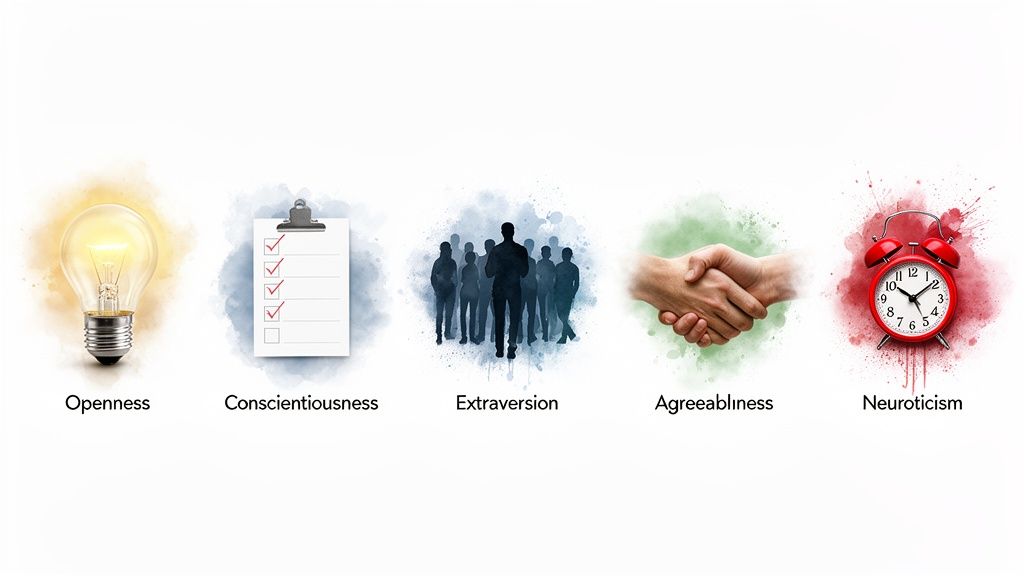
The Big Five gives us a language to understand the beautiful complexity of who we are. But to truly grasp it, we need to move past the clinical terms and see these traits as they live and breathe in our everyday lives.
So, let's toss out the dry, academic definitions. Instead, we'll explore each dimension through relatable analogies and real-world scenarios. Think of these five traits not as rigid boxes, but as the fundamental settings that shape your personal operating system. When you understand them, you can start seeing your own patterns with incredible clarity and compassion.
Openness: Your Mental Appetite
Openness to Experience is really just a measure of your mental appetite. How hungry are you for new ideas, fresh perspectives, and uncharted adventures? This isn't about how smart you are, but how much you crave engagement with the unknown and thrive on unconventional thinking.
Someone with a high mental appetite is always ready to explore. They’re the friend who orders the most unusual dish on the menu just to see what it's like, gets completely lost in a fantasy novel for hours, or throws out a wonderfully wild idea during a brainstorming session. For them, the world is an endless buffet of fascinating things to discover.
On the other hand, those with a more focused appetite find strength and comfort in the familiar. They appreciate a well-worn routine, the cozy feeling of a favorite movie, and practical, proven solutions to problems. Their gift is bringing stability, reliability, and a grounded perspective to the world around them.
Conscientiousness: Your Internal Project Manager
Think of Conscientiousness as your own internal project manager. It’s the part of you that governs self-discipline, organization, and follow-through. It’s that inner voice reminding you about a deadline, nudging you to double-check your work, and inspiring you to see a goal all the way to the finish line.
A person with a highly active internal project manager is the epitome of reliable. Their calendars are works of art, they always keep their promises, and they tackle their goals with a steady, methodical focus. They are the bedrock of any team, the ones who make sure the grand vision actually becomes a reality.
Someone lower in this trait operates with more spontaneity and flexibility. They are less concerned with rigid plans and find their flow in the moment. This makes them brilliant at improvising and thriving in environments that value adaptability over strict schedules.
Your Big Five profile is not a verdict on your character; it is a map of your natural energy flows. Every setting has its own unique genius and its own set of challenges.
Extraversion: Your Social Battery
Extraversion is all about your social battery—what charges you up and what drains you down. It’s a common myth that this is simply about being loud versus being shy. The real question is this: do you gain energy from being around people, or do you need solitude to feel truly recharged?
High Extraversion (Extroverts): These are folks whose social battery gets a boost from interaction. They feel lit up by lively conversations, group activities, and the buzz of the outside world. Too much time alone can leave them feeling flat and uninspired.
Low Extraversion (Introverts): For these individuals, social settings slowly deplete their battery, while quiet time alone plugs it back in. They can be incredibly warm and engaging, but they need that solitude to process their thoughts and restore their energy reserves.
Understanding how your personal social battery works is a game-changer for managing your energy and avoiding burnout. It explains why one person leaves a party feeling electric while another needs a whole day to recover.
Agreeableness: Your Collaboration Instinct
Next up is Agreeableness, which you can think of as your collaboration instinct. It shines a light on your natural orientation toward others. Do you tend to prioritize harmony and cooperation, or are you more driven by directness and individual conviction?
People with a strong collaboration instinct are often deeply empathetic, trusting, and compassionate. They’re naturally attuned to the feelings of others and are motivated to keep relationships positive, sometimes avoiding conflict to maintain the peace. Their supportive nature makes them incredible team players and truly wonderful friends.
Those with a more independent instinct are typically more direct and analytical. They are less focused on pleasing everyone and more interested in getting to the objective truth. This makes them fantastic critical thinkers and skilled negotiators who aren't afraid to challenge an idea to find the very best solution.
Neuroticism: Your Emotional Alarm System
Finally, we have Neuroticism, which is best understood as your emotional alarm system. This trait measures your overall emotional stability and how sensitive your system is to stress, perceived threats, and negative feelings.
A highly sensitive alarm system (high Neuroticism) means you're wired to experience emotions like anxiety, worry, and sadness more deeply and frequently. While this can make navigating stress a bit tougher, this sensitivity is also a profound source of empathy, creativity, and self-awareness.
A less sensitive alarm system (low Neuroticism) points to a natural emotional resilience. These individuals tend to stay calm and steady, even when the pressure is on. They’re less prone to worry and can bounce back from life's curveballs with relative ease.
Knowing the sensitivity of your own alarm system is incredibly empowering. It helps you understand your emotional triggers and develop strategies to manage your energy, turning powerful self-awareness into your greatest strength.
Why the Big Five Is Different from Other Personality Systems
You’ve probably bumped into personality quizzes all over the internet, from lighthearted ones that tell you which fantasy character you are to more serious frameworks like the Myers-Briggs Type Indicator (MBTI). So, what makes the Big Five so special in this crowded space?
The answer is simple but profound: the Big Five measures traits, not types.
Imagine trying to describe the weather. A type-based model is like saying it's either "Hot" or "Cold." It's a quick label, but it misses all the beautiful detail. Is it a crisp autumn morning? A humid summer day? A single label just can't capture that reality.
The Big Five, on the other hand, is like a thermometer. It gives you a precise reading along a scale. You aren’t just an "introvert" or an "extrovert." Instead, you might score 35% on Extraversion, which paints a much richer picture: someone who enjoys their quiet time but can absolutely rise to the occasion in social settings. This spectrum-based approach gives you a portrait of yourself that’s actually true to life.
The Power of Spectrums Over Labels
This isn't just a minor academic detail—it's the very reason the Big Five is the gold standard in psychological research. Type-based systems, for all their popularity, can be a bit of a trap. They sort you into a neat little box, and while that can feel affirming at first, it often oversimplifies the incredible complexity of who you truly are.
The Big Five steers clear of rigid categories. It honors your unique makeup by showing you where you land on each of the five core dimensions. This approach has some serious advantages:
- It captures nuance. The model reflects the reality that most of us are a blend of traits. You can be both highly conscientious and wonderfully open to new things, creating a profile that’s all your own.
- It’s incredibly reliable. Your Big Five scores tend to remain remarkably stable throughout your adult life. Unlike type-based tests where your "type" can change from one week to the next, this model gives you a consistent, dependable snapshot.
- It's backed by science. The Big Five wasn't dreamed up from an abstract theory. It was built on a mountain of data-driven research and has been tested and confirmed across countless cultures and countries. These five traits are, it turns out, a fundamental part of the human experience.
This rock-solid scientific foundation is what truly sets it apart. The model’s discovery was a story of collaborative research, with pioneers like L.L. Thurstone using statistical methods back in the 1930s to find that personality words naturally clustered into five distinct groups. This mathematical approach, sharpened over decades, cemented the Big Five's place as our most robust framework. You can read more about the fascinating story of how the Big Five model was developed on truity.com.
Comparing the Models Side-by-Side
To really see the difference, it helps to put the Big Five and the MBTI—one of the most famous type-based systems—head-to-head.
It's clear that while both systems aim for self-understanding, they come from very different places and offer very different kinds of insight.
| Feature | Big Five (OCEAN) | Myers-Briggs (MBTI) |
|---|---|---|
| Foundation | Data-driven; emerged from statistical analysis of language. | Based on Carl Jung's theory of psychological types. |
| Measurement | Trait-based (Spectrum): Measures where you fall on a continuum for each of the five traits. | Type-based (Binary): Assigns you to one of 16 distinct personality "types." |
| Results | Provides percentile scores for each trait (e.g., 75th percentile in Agreeableness). | Gives you a four-letter code (e.g., INFJ or ESTP). |
| Scientific Standing | Widely accepted as the gold standard in personality psychology. | Popular in corporate settings but has limited support in academic psychology. |
Ultimately, the Big Five wasn’t designed to hand you a convenient label. It was designed to give you a map and a compass.
The goal of the Big Five isn’t to give you a label to identify with. Its purpose is to give you a map and a compass, empowering you with the self-awareness to navigate your life with greater intention and understanding.
While other systems can be a fun entry point into self-reflection, the Big Five offers a depth, accuracy, and scientific credibility that is simply in another league. It moves beyond simple boxes to give you a genuinely personalized and actionable way of understanding your inner world.
Putting Your Personality Insights into Action

Learning your personality profile isn’t the finish line—it’s the starting gate. This kind of self-awareness is an incredibly powerful tool, but just like any tool, its real worth is in how you use it. Knowledge without action is just trivia, after all.
So, let's shift from understanding the what to mastering the how. It's time to turn your unique Big Five profile into a practical roadmap for a life lived with more intention and a whole lot more fulfillment.
This isn’t about fighting who you are; it’s about working with your natural wiring to design a life that honors your core self. We’ll dive into real-world strategies you can use today across three of life’s most important areas: your career, your relationships, and your own well-being.
Crafting a Career That Energizes You
Your personality is probably the single best predictor of whether you’ll find your work satisfying and successful. When your job aligns with your natural traits, you don’t just perform better—you feel more alive. But when it’s a mismatch? That’s a fast track to burnout and feeling stuck.
A great first move is to use your profile as a compass. Someone high in Extraversion, for example, is going to feel utterly drained in a quiet, solitary role but will absolutely light up in collaborative, people-focused positions like sales or team leadership. On the flip side, a person who scores lower in Extraversion might discover their genius in deep, focused work like research, coding, or writing.
Or think about your Conscientiousness score. A high score means you're practically built for roles that demand precision, planning, and dependability—think project management, accounting, or law. If you score lower, you're likely to thrive in dynamic, fast-paced environments that reward improvisation and adaptability, like a creative startup or emergency services.
Your ideal career isn’t just about what you do; it’s about creating an environment where who you are is your greatest asset.
Here are a few quick ways to lean into your strengths:
- High Openness: Actively look for roles that involve brainstorming, innovation, and constant learning. Pitch that creative side project you’ve been thinking about, or sign up for a workshop to learn a new skill.
- High Agreeableness: You're a natural collaborator. Volunteer to mentor a new teammate or take the lead on a project that needs someone to build consensus and bring people together.
- Low Agreeableness: Your superpower is objective, critical thinking. Lean into roles where you can analyze systems, challenge outdated assumptions, and find the most logical solutions, free from bias.
Building Deeper, More Authentic Relationships
The way you’re wired profoundly shapes how you connect with others. Understanding your traits—and getting curious about the traits of the people you love—can transform your relationships from a source of friction into a deep well of empathy and support.
Take Agreeableness, for instance. A classic clash happens between someone highly agreeable and someone who isn't. The high-scorer just wants harmony and might swallow their true feelings to keep the peace. The low-scorer values blunt honesty and might have no idea their words are coming across as harsh.
Recognizing this pattern isn't about deciding who's "right." It's about learning to speak each other's language. The agreeable person can practice being a little more direct, while the less agreeable partner can practice softening their delivery.
Differences in Neuroticism can also set the emotional temperature in a relationship. A partner high in Neuroticism often needs more reassurance and a stable, predictable environment to feel safe. Their partner, who might be low in Neuroticism, may not even notice that need. Knowing this allows the more resilient partner to offer support proactively, turning what could have been a fight into a moment of true connection. When you feel this kind of recurring friction, it can be helpful to explore resources that address why you might feel stuck in life, as relationship dynamics are often a huge part of the puzzle.
Nurturing Your Personal Well-Being
Finally, and perhaps most importantly, your Big Five profile is like a personalized instruction manual for taking care of yourself. It shows you how to manage your energy, handle stress, and create a daily life that feels genuinely good to you.
If you're high in Neuroticism, this self-awareness is your superpower. You know your emotional alarm system is a bit more sensitive, so you can build a proactive "stress toolkit." This might look like a daily mindfulness practice, a non-negotiable exercise routine, or setting firm boundaries to protect your peace.
Your Openness score is a great guide for how you should relax and recharge. A highly open person will feel stagnant and bored without new experiences, so scheduling time to visit a museum, try a new recipe, or explore a different part of town is essential. Someone lower in Openness, however, will find deep comfort and restoration in familiar routines and beloved hobbies.
When you start aligning your daily choices with your innate personality, you stop swimming against the current. You begin to flow with it. That’s where you unlock a deeper sense of ease, purpose, and authentic happiness.
Your Big Five Questions, Answered
As you start to see yourself in the Big Five model, some natural questions are bound to pop up. Let's tackle a few of the most common ones so you can feel completely confident in what this test can reveal about you.
Just How Accurate Is This Thing?
This is always the first question, and for good reason! The answer is what sets the Big Five apart from so many other personality quizzes out there. It’s widely considered the gold standard in psychological science—the most rigorously tested, scientifically validated, and reliable model we have.
Its strength comes from decades of research across countless cultures and populations. Unlike tests that might give you a different result next week, the Big Five has incredibly high test-retest reliability. That means your core profile stays remarkably consistent over your lifetime, giving you a solid, trustworthy map of your inner world.
Can I Actually Change My Personality Traits?
Your core traits are pretty stable, especially in adulthood. They represent your fundamental wiring. But—and this is a big but—that doesn't mean you're stuck. Think of your Big Five profile as your natural starting point, not your final destination.
While you probably won't do a complete 180 and go from being a deep introvert to a life-of-the-party extrovert, you can absolutely grow and evolve. Life experience and intentional effort can soften your edges. You can build habits to become more organized (nudging up your Conscientiousness) or learn new ways to handle anxiety (dialing down Neuroticism). It's this beautiful dance between a stable core and our capacity for growth that makes the journey of self-discovery so exciting.
Your Big Five profile isn’t a life sentence; it’s a user manual. It reveals your factory settings so you can learn to operate yourself with greater skill, compassion, and intention.
So, Is There a "Best" Personality Profile to Have?
Not a chance. Every single combination of traits is its own unique tapestry of strengths and potential growth areas. There is no such thing as a “perfect” score. The world needs the wild creativity of people high in Openness just as much as it needs the dependable stability of those who favor tradition.
We need the warm, collaborative spirit of high Agreeableness alongside the pragmatic, objective thinking of those who score lower on that trait. Understanding what the Big Five personality test really shows you is about self-acceptance and empowerment, not judgment. It’s about learning to lean into what makes you you.
Ready to move beyond generic advice and get insights calibrated to your unique personality? Cosmic Mind integrates your Big Five profile with real-time astronomical data to provide a clear, actionable roadmap for your life. Discover your personal rhythm and start making decisions with confidence. Get your free reading and see how it works.